Ultimate Guide to Mastering the BTU Civil 4th Sem Mechanics of Solids Exam in
Introduction to BTU Mechanics of Solids Preparation
Mechanics of Solids (widely known as Strength of Materials or MOS) is the foundational backbone of 2nd-year Civil Engineering—governing how beams, shafts, columns, and structural members behave under axial loads, bending moments, shear forces, and torsional twists. Because the university examination heavily emphasizes multi-step diagram problems and classical structural derivations, solving a btu mechanics of solids previous year question paper is the most effective way to master sign conventions, elastic constant relations, and complex beam loading scenarios.
Whether you are looking for an instant btu civil 4th sem mechanics of solids pyq pdf download or browsing our complete bikaner technical university btech civil 4th sem question papers archive, you will quickly notice a clear pattern: nearly 80% of the question paper revolves around Shear Force and Bending Moment Diagrams (SFD & BMD), Principal Stresses using Mohr's Circle, Flexure and Torsion equations, Macauley's beam deflection method, and Euler's column buckling theory.
Pro tip for BTU 4th Sem Civil students: Since stress transformation, shear strength, and differential equations directly overlap with soil mechanics and open-channel pressure forces, pair your revision with our BTU Civil 4th Sem Geotechnical Engineering PYQs and Hydraulics Engineering Question Papers.
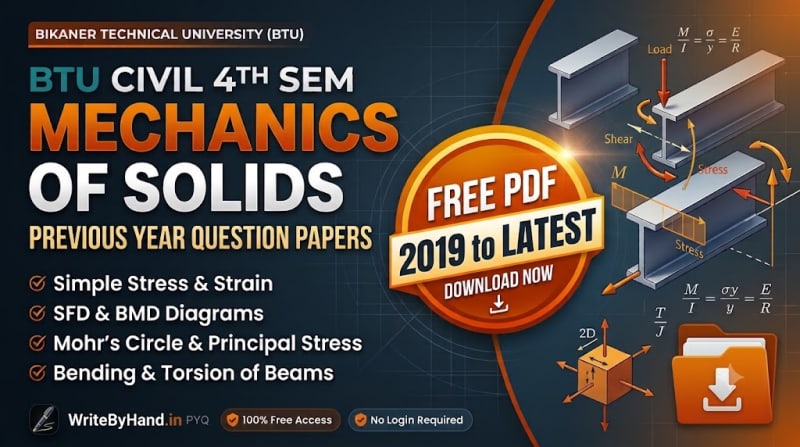
Decoding the BTU Civil 4th Sem Mechanics of Solids Syllabus & Pattern
The BTU end-semester theory examination follows a three-tier structure: Part A (10 compulsory short-answer questions of 2 marks each covering Hooke's law, Poisson's ratio, point of contraflexure, section modulus, and slenderness ratio), Part B (analytical derivations, Mohr's circle constructions, and moderate numericals where you attempt 4 to 5 questions out of 7), and Part C (high-weightage numerical and design problems on SFD & BMD, shear stress distribution in beams, deflection of beams, and column buckling). Reviewing our mechanics of solids unit wise important topics btu civil breakdown below will help you prioritize the highest-scoring modules first:
- Module 1: Simple Stress-Strain, Principal Stresses, SFD & BMD, and Bending & Shear Stresses Analyzing any mechanics of solids btech 2nd year civil previous year paper reveals that over 50% of the question paper focuses on stress-strain mechanics and beam diagrams. Practicing sfd and bmd numericals btu civil exam—specifically for Cantilever, Simply Supported, and Overhanging beams subjected to point loads, UDL, UVL, and couples—alongside mohr circle and principal stress questions btu (normal/tangential stress on inclined planes, major/minor principal stresses $\sigma_{1,2} = \frac{\sigma_x+\sigma_y}{2} \pm \sqrt{(\frac{\sigma_x-\sigma_y}{2})^2 + \tau_{xy}^2}$, elastic constant derivations $E = 2G(1+\mu) = 3K(1-2\mu)$, Flexure formula $\frac{M}{I} = \frac{\sigma}{y} = \frac{E}{R}$, and shear stress distribution $\tau = \frac{FA\bar{y}}{Ib}$ across Rectangular, Circular, I, and T sections) guarantees full marks in Part B and Part C.
- Module 2: Deflection of Beams, Torsion of Circular Shafts, Columns & Thin Cylinders The second half of the syllabus covers structural deformation, shaft torque transmission, and stability of compression members. Mastering bending stress torsion and deflection of beams numericals btu—including Double Integration, Macauley's Method for discontinuous loads, Moment-Area theorems, and Conjugate Beam method—is essential. Furthermore, deriving the Torsion Equation ($\frac{T}{J} = \frac{\tau}{R} = \frac{G\theta}{L}$), comparing solid vs hollow circular shafts for power transmission ($P = \frac{2\pi NT}{60}$), solving hoop and longitudinal stresses in Thin Cylindrical/Spherical shells, and deriving Euler's critical buckling load ($P_{cr} = \frac{\pi^2 EI}{L_e^2}$) vs Rankine's empirical formula for long and intermediate columns appear in Part C almost every single year.
High-Yield Topics That Repeat Every Year:
- SFD & BMD for Overhanging & Simply Supported Beams (Point of Contraflexure)
- Relationship Between Elastic Constants ($E, G, K, \mu$) & Thermal Stress
- Principal Stresses, Oblique Planes & Mohr's Circle Construction
- Theory of Simple Bending Derivation & Shear Stress in I / T Sections
- Slope & Deflection of Beams by Macauley's & Moment-Area Method
- Torsion of Solid/Hollow Shafts & Euler's Column Theory (4 End Conditions)
Section-Wise Strategy Using BTU Mechanics of Solids Past Papers:
1. Score 20/20 in Part A (2-Mark Short Questions)
Part A tests crisp structural definitions, stress-strain curves, and fundamental formulas. Reviewing the mechanics of solids important questions btu from the last 5 years shows that 2-mark questions on Hooke's Law & Elastic Limit, Poisson's Ratio, Bulk Modulus, Point of Contraflexure vs Point of Inflection, Section Modulus ($Z = I/y_{\max}$), Polar Moment of Inertia, Torsional Rigidity ($GJ$), Flexural Rigidity ($EI$), Effective Length of Columns, and Slenderness Ratio repeat almost every year.
2. Ace Part B with Clean Derivations & Mohr's Circle Diagrams
If you are wondering how to pass mechanics of solids in btu with an 80+ score, the secret is drawing clean free-body diagrams (FBDs), stress-strain curves for mild steel, and scaled Mohr's Circles alongside every derivation. Practicing from a structured btech civil sem 4 mechanics of solids question bank—especially deriving the relation $E = \frac{9KG}{3K+G}$, composite bar thermal stress problems, pure bending assumptions, and thin cylinder volumetric strain derivations—ensures maximum step-marking.
3. Conquer Part C Long Numericals on SFD-BMD, Deflection & Torsion
Part C carries the highest weightage per question and focuses on multi-step structural numericals: plotting Shear Force and Bending Moment diagrams for overhanging beams and locating zero-BM points, sketching shear stress distribution across unsymmetrical T or symmetrical I-beams, finding maximum deflection via Macauley's method, or designing hollow circular shafts under combined bending and torsion. Students preparing for supplementary exams must also practice from the btu mechanics of solids back paper pdf download archive, as Back paper numericals on Euler's buckling load and SFD-BMD frequently reappear in Main exams.
How to Study Effectively with Our BTU Civil PYQ Archives:
- Download the btu 4th sem civil last 5 years question papers pdf from the download box above and highlight repeated derivations and numericals on SFD & BMD, Mohr's Circle, Simple Bending, and Beam Deflection.
- Practice step-by-step support reaction and stress distribution numericals and verify your calculations using a btu mechanics of solids solved paper pdf or standard textbooks (like Dr. R.K. Bansal, R.S. Khurmi, S. Ramamrutham, or Beer & Johnston).
- Pair your numerical practice with concise mechanics of solids btu notes and formula sheet pdf revision cards containing all Elastic Constant relations, standard beam slopes/deflections, Torsion formulas, and Euler's effective length factors for rapid exam-morning revision.
Common Mistakes to Avoid in the BTU Mechanics of Solids Exam:
- Mixing Up Sagging and Hogging Sign Conventions in SFD & BMD: In overhanging beam problems, students frequently forget to equate the Bending Moment equation to zero to find the exact Point of Contraflexure, or confuse parabolic (UDL) vs cubic (UVL) curve profiles on the BMD plot.
- Incorrect Neutral Axis ($\bar{y}$) and Moment of Inertia ($I_{NA}$) in T-Sections: When solving bending or shear stress distribution for unsymmetrical T-beams, forgetting to apply the Parallel Axis Theorem ($I = I_G + Ah^2$) about the centroidal Neutral Axis leads to completely wrong maximum tensile and compressive stress values.
- Using Actual Length ($L$) Instead of Effective Length ($L_e$) in Euler's Column Formula: Always check the column end conditions carefully—both ends pinned ($L_e = L$), both ends fixed ($L_e = L/2$), one end fixed and other free ($L_e = 2L$), or one end fixed and other hinged ($L_e = L/\sqrt{2}$)—and ensure consistent units ($N$ and $mm$) before calculating critical buckling load.
A quick trick to revise before the exam:
Memorizing all standard cantilever/simply-supported beam deflection formulas, Elastic Constant relations, Principal Stress equations, and Euler's column end-condition ratios on the night before your BTU exam can feel overwhelming.
You can use our free Exam Cheat Sheet Generator tool to create a 1-page revision sheet. Compile all Flexure & Torsion equations, Mohr's Circle formulas, SFD-BMD curve rules, and Thin Cylinder stress equations into a clean A4-sized PDF sheet in seconds!
Are you in need of more free engineering student tools? Then, head over to WriteByHand.in's Homepage and explore our 100+ assignment maker tools, PDF utilities, and text-to-handwriting converters!
*Disclaimer: Please note that the above-mentioned past papers have been collected from various sources and previous B.Tech candidates. WriteByHand.in does not claim ownership of these materials. We are simply sharing these resources to help current students with their Bikaner Technical University (BTU) Semester exams.