Ultimate Guide to Mastering the BTU Civil 4th Sem Environmental Engineering Exam in
Introduction to BTU Environmental Engineering Preparation
Environmental Engineering is one of the highest-scoring core subjects in 2nd-year Civil Engineering, connecting public health infrastructure with hydraulic design—from municipal water treatment plants and sewerage networks to biological wastewater reactors and air pollution control. Because the university paper blends process flow diagrams with step-by-step design numericals, solving a btu environmental engineering previous year question paper is the most reliable way to see how examiners frame problems on population forecasting, sedimentation tank sizing, BOD kinetics, and secondary sewage treatment.
Whether you are looking for an instant btu civil 4th sem environmental engineering pyq pdf download or exploring our complete bikaner technical university btech civil 4th sem question papers collection, you will quickly spot a clear scoring pattern: nearly 80% of the exam revolves around Arithmetic and Geometric population forecasting, Coagulation & Rapid Sand Filtration, Breakpoint Chlorination, 5-day BOD calculations, and comparing the Activated Sludge Process (ASP) with Trickling Filters.
Pro tip for BTU 4th Sem Civil students: Since open-channel sewer hydraulics, settling velocity, and differential BOD rate equations rely heavily on fluid flow and calculus fundamentals, pair your revision with our BTU Civil 4th Sem Hydraulics Engineering PYQs and Advanced Engineering Mathematics Question Papers.
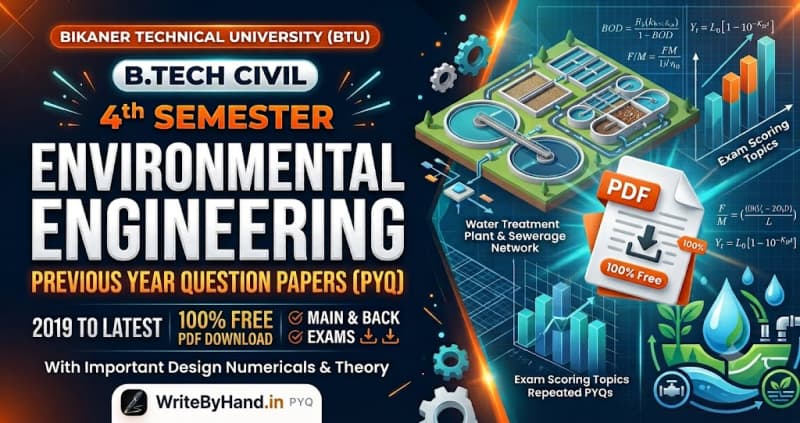
Decoding the BTU Civil 4th Sem Environmental Engineering Syllabus & Pattern
The BTU end-semester theory examination follows a three-tier structure: Part A (10 compulsory short-answer questions of 2 marks each covering drinking water standards IS 10500, per capita demand, BOD/COD definitions, and air pollutants), Part B (water and sewage treatment theory, sewer hydraulics, and moderate numericals where you attempt 4 to 5 questions out of 7), and Part C (high-weightage design problems on sedimentation tanks, rapid sand filters, BOD kinetics, and biological reactors). Reviewing our environmental engineering unit wise important topics btu civil breakdown below will help you prioritize the highest-scoring modules first:
- Module 1: Water Demand, Quality Standards & Water Treatment Processes Analyzing any environmental engineering btech 2nd year civil previous year paper reveals that nearly 45% of the exam tests types of water demand, fire demand formulas (Kuichling's, Freeman's, Buston's), physical/chemical/bacteriological water quality parameters, and unit operations in water treatment. Practicing water treatment and population forecasting numericals btu—specifically Arithmetic Increase, Geometric Increase, and Incremental Increase methods, Stokes' law discrete particle settling, surface overflow rate ($v_0 = Q / A$), Alum coagulation reactions, Slow vs Rapid Sand Filter backwashing, and Breakpoint Chlorination curves—guarantees full marks in Part B and Part C.
- Module 2: Sewerage Systems, Wastewater Treatment, Solid Waste & Air Pollution The second half of the syllabus covers sanitary engineering, biological wastewater treatment, and environmental pollution control. Mastering sewage treatment and bod numericals btu exam topics—such as estimating dry weather flow (DWF) vs wet weather flow, minimum self-cleansing velocity, Manning's sewer design formula, first-order BOD reaction kinetics ($Y_t = L_0 [1 - 10^{-K_D t}]$), temperature correction for deoxygenation constant ($K_T = K_{20} \theta^{T-20}$), and Oxygen Sag Curve (Streeter-Phelps equation)—is essential. Furthermore, activated sludge process and rapid sand filter questions btu (including Food-to-Microorganism $F/M$ ratio, Sludge Volume Index $SVI$, Trickling Filter recirculation, Septic Tank design, Sanitary Landfilling, and Electrostatic Precipitators / Cyclone Separators) appear in Part C almost every single year.
High-Yield Topics That Repeat Every Year:
- Population Forecasting (Arithmetic, Geometric & Incremental)
- IS 10500 Drinking Water Standards (Turbidity, pH, Hardness, MPN)
- Plain Sedimentation vs Alum Coagulation & Rapid Sand Filters
- Breakpoint Chlorination Curve & Water Softening (Lime-Soda/Zeolite)
- 5-Day BOD Calculation, COD, TOC & Streeter-Phelps Oxygen Sag Curve
- Activated Sludge Process (ASP), Trickling Filters & Air/Noise Control
Section-Wise Strategy Using BTU Environmental Engineering Past Papers:
1. Score 20/20 in Part A (2-Mark Short Questions)
Part A tests standard permissible limits, definitions, and crisp environmental formulas. Reviewing the environmental engineering important questions btu from the last 5 years shows that 2-mark questions on Per Capita Water Demand ($135\text{ lpcd}$), Peak Factor, Carbonate vs Non-Carbonate Hardness, Fluoridation & Defluoridation (Nalgonda technique), Self-Cleansing vs Non-Scouring Velocity, Sludge Volume Index (SVI), Primary vs Secondary Air Pollutants, Photochemical Smog, and Decibel ($\text{dB}$) noise scale repeat almost every year.
2. Ace Part B with Treatment Flowcharts & Neat Unit Sketches
If you are wondering how to pass environmental engineering in btu with an 80+ score, the secret is drawing labeled cross-sections of treatment units alongside tabular comparisons. Practicing from a structured btech civil sem 4 environmental engineering question bank—especially Slow Sand vs Rapid Sand Filter tables, Breakpoint Chlorination graphs, Drop Manhole & Inverted Siphon diagrams, and Composting vs Sanitary Landfilling flowcharts—ensures maximum step-marking.
3. Conquer Part C Long Design Problems on Water & Sewage Treatment
Part C carries the highest weightage per question and focuses on multi-step engineering design: forecasting population for 3 decades, sizing a rectangular sedimentation tank and rapid sand filter with wash-water troughs, computing 5-day BOD and ultimate BOD, or designing a Trickling Filter / Septic Tank. Students preparing for supplementary exams must also practice from the btu environmental engineering back paper pdf download archive, as Back paper numericals on BOD reaction rate constants and Activated Sludge F/M ratio frequently reappear in Main exams.
How to Study Effectively with Our BTU Civil PYQ Archives:
- Download the btu 4th sem civil last 5 years question papers pdf from the download box above and highlight repeated numericals on Population Forecasting, Sedimentation Tank design, 5-day BOD kinetics, and Activated Sludge Process.
- Practice step-by-step design assumptions (detention time, surface overflow rate, filtration rate) and verify your calculations using a btu environmental engineering solved paper pdf or standard textbooks (like S.K. Garg Vol. 1 & 2, Peavy, Rowe & Tchobanoglous, or Dr. B.C. Punmia).
- Pair your numerical practice with concise environmental engineering btu notes and formula sheet pdf revision cards containing IS 10500 drinking water limits, fire demand equations, BOD temperature corrections, and ASP/Trickling Filter design parameters for rapid exam-morning revision.
Common Mistakes to Avoid in the BTU Environmental Engineering Exam:
- Unit Conversion Errors in Design Discharge ($Q$): When designing a sedimentation tank or rapid sand filter, students often forget to multiply average daily water demand by the maximum daily factor ($1.8$) or fail to convert Million Liters per Day ($\text{MLD}$) into $\text{m}^3/\text{day}$ or $\text{m}^3/\text{hr}$ before dividing by the Surface Overflow Rate.
- Confusing Base-$10$ ($K_D$) and Base-$e$ ($k$) in BOD Equations: In first-order BOD numericals, mixing up $Y_t = L_0 (1 - 10^{-K_D t})$ with $Y_t = L_0 (1 - e^{-k t})$ (where $k = 2.303 K_D$), or forgetting to adjust the rate constant for temperature using $K_T = K_{20} (1.047)^{T-20}$, leads to wrong Ultimate BOD values.
- Omitting Backwash Water Allowance in Rapid Sand Filters: While calculating the net area of a Rapid Sand Filter, students frequently forget to account for the $2\%$ to $4\%$ filtered water consumed during daily backwashing and the $30\text{ minutes}$ lost for cleaning operations.
A quick trick to revise before the exam:
Memorizing all IS 10500 drinking water limits, population forecasting formulas, sedimentation & filtration design criteria, and BOD/ASP equations on the night before your BTU exam can feel overwhelming.
You can use our free Exam Cheat Sheet Generator tool to create a 1-page revision sheet. Compile all water quality standards, Stokes' law formulas, BOD kinetics, and F/M & SVI equations into a clean A4-sized PDF sheet in seconds!
Are you in need of more free engineering student tools? Then, head over to WriteByHand.in's Homepage and explore our 100+ assignment maker tools, PDF utilities, and text-to-handwriting converters!
*Disclaimer: Please note that the above-mentioned past papers have been collected from various sources and previous B.Tech candidates. WriteByHand.in does not claim ownership of these materials. We are simply sharing these resources to help current students with their Bikaner Technical University (BTU) Semester exams.