Ultimate Guide to Mastering the BTU Civil 3rd Sem Building Materials Exam in
Introduction to BTU Building Materials Preparation
Every mega-structure in Civil Engineering begins with selecting the right raw materials—ranging from high-strength quarried stones and first-class burnt clay bricks to Ordinary Portland Cement (OPC), structural timber, and modern admixtures. Because Building Materials is a 100% conceptual and descriptive subject in the third semester, it offers a golden opportunity to boost your overall SGPA with minimal numerical stress. Solving a btu building materials previous year question paper is the most reliable way to identify which IS code laboratory tests, kiln diagrams, and material properties are repeatedly asked by university examiners.
Whether you are looking for a quick btu civil 3rd sem building materials pyq pdf download or exploring our complete bikaner technical university btech civil 3rd sem question papers repository, you will notice a clear pattern: nearly 80% of the paper revolves around standard manufacturing flowcharts, Bogue's compounds in cement, brick testing standards, and timber seasoning techniques.
Pro tip for BTU 3rd Sem Civil students: Since Building Materials and Construction go hand-in-hand during your 2nd-year exams, pair your material study with our BTU Civil 3rd Sem Architecture Drawing & Building Construction (ADBC) PYQs and Strength of Materials (SOM) Question Papers.
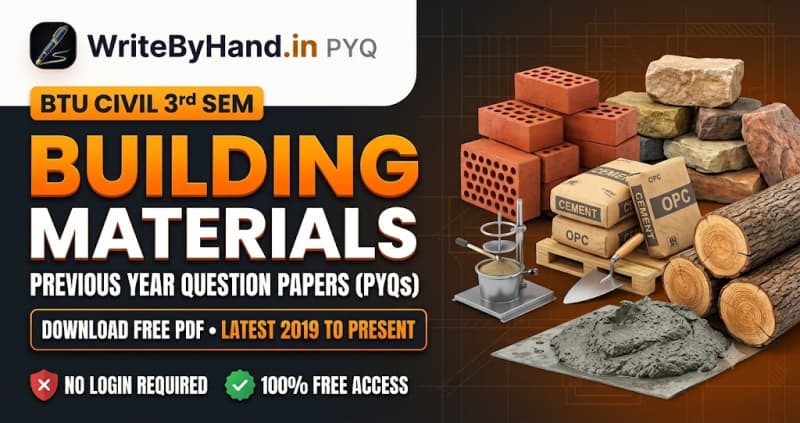
Decoding the BTU Civil 3rd Sem Building Materials Syllabus & Pattern
The BTU end-semester theory examination is divided into three structured sections: Part A (10 compulsory short-answer definitions and IS specification questions of 2 marks each), Part B (analytical comparisons, chemical compositions, and apparatus diagrams where you attempt 4 to 5 questions out of 7), and Part C (comprehensive manufacturing processes, kiln sketches, and laboratory testing procedures). Reviewing our building materials unit wise important topics btu civil engineering breakdown below will help you prioritize the highest-scoring units:
- Module 1: Stones, Clay Bricks, Cement & Lime Analyzing any building materials and construction btech 2nd year civil previous year paper reveals that over 55% of the exam focuses on traditional masonry materials and binders. Practicing stones bricks and cement testing questions btu—such as geological vs chemical classification of rocks, Stone Quarrying & Dressing, Harmful ingredients in Brick Earth, Hoffmann's Kiln vs Bull's Trench Kiln, and Bogue's Compounds ($C_3S, C_2S, C_3A, C_4AF$) in OPC—guarantees full marks in Part B and Part C. Furthermore, questions on vicat apparatus and brick testing questions btu (Crushing Strength, Water Absorption, Efflorescence, Le-Chatelier Soundness, and Fineness Test) appear in almost every single exam session.
- Module 2: Timber, Mortar, Concrete, Paints & Modern Materials The second half of the syllabus covers structural wood, composites, and protective coatings. Preparing timber defects seasoning and concrete mix important questions btu exam sets—including Cross Section of an Exogenous Tree, Natural vs Kiln Seasoning of Timber, Star/Heart/Cup Shakes, Dry Rot vs Wet Rot, and Preservation methods (ASCU treatment, Creosoting)—easily secures 20+ marks. Don't skip Fly Ash, Gypsum, Poisons/Bulking of Sand, Constituents of Oil Paints/Varnishes, and Ferrous/Non-Ferrous metals for Part A and Part B.
High-Yield Topics That Repeat Every Year:
- Hoffmann's Kiln vs Bull's Trench Kiln (Brick Burning)
- Bogue's Compounds ($C_3S, C_2S, C_3A, C_4AF$) & Cement Types
- Vicat Apparatus (Consistency, Initial & Final Setting Time)
- IS Code Tests on Stones & Bricks (Absorption, Crushing, Attrition)
- Timber Structure, Kiln Seasoning & Natural/Conversion Defects
- Fat vs Hydraulic Lime, Bulking of Sand & Paint Constituents
Section-Wise Strategy Using BTU Building Materials Past Papers:
1. Score 20/20 in Part A (2-Mark Short Questions)
Part A tests exact IS code values, chemical percentages, and crisp 3-line definitions. Reviewing the building materials important questions btu from the last 5 years shows that questions on Standard vs Modular Brick size ($190 \times 90 \times 90\text{ mm}$), Function of Frog, Efflorescence, Slaking & Calcination of Lime, Bulking of Sand, Initial/Final setting time of OPC (30 mins & 600 mins), and Seasoning of Timber repeat almost every year. Always mention the relevant IS Code (like IS 1077 for bricks or IS 269 for OPC) to impress the evaluator.
2. Ace Part B with Comparison Tables & Apparatus Sketches
If you are wondering how to pass building materials in btu with an 80+ score, the secret is replacing long theory paragraphs with side-by-side comparison tables and neat pencil diagrams. Practicing from a comprehensive btech civil sem 3 building materials question bank—especially tabular comparisons like Clamp vs Kiln burning, Wet vs Dry process of cement, Fat Lime vs Hydraulic Lime, and sketches of Vicat Apparatus, Le-Chatelier flask, and Exogenous tree cross-sections—will save time and fetch full marks.
3. Conquer Part C Manufacturing Flowcharts & Lab Procedures
Part C carries the highest weightage per question and typically asks for complete manufacturing processes (4 stages of Brick Manufacturing: Preparation of clay, Moulding, Drying, and Burning; or Rotary Kiln Cement production) alongside detailed laboratory test procedures. Students preparing for supplementary exams must also go through the btu building materials back paper pdf download files, as Back paper questions on Timber defects, Paint constituents (Base, Vehicle, Drier, Solvent, Thinner), and Special Cements (Rapid Hardening, Low Heat, Sulphate Resisting) frequently repeat in Main exams.
How to Study Effectively with Our BTU Civil PYQ Archives:
- Download the btu 3rd sem civil last 5 years question papers pdf from the download box above and highlight all repeated questions on Stones, Bricks, Cement, and Timber before reading your textbook.
- Practice drawing manufacturing flowcharts and testing apparatus sketches, then verify your chemical oxide percentages and IS limits using a btu building materials solved paper pdf or standard reference books (like S.K. Duggal, B.C. Punmia, or Rangwala).
- Combine your past paper practice with concise building materials btu notes and pyq pdf revision sheets containing all oxide compositions of clay/cement, standard test values, and timber defects for rapid last-night revision.
Common Mistakes to Avoid in the BTU Building Materials Exam:
- Confusing Standard Modular vs Nominal Brick Size: Many students mix up the standard modular brick dimension ($19 \times 9 \times 9\text{ cm}$ without mortar) with the nominal size ($20 \times 10 \times 10\text{ cm}$ with mortar) in Part A, losing easy marks.
- Mixing Up Bogue's Compounds Functions: Confusing Tricalcium Silicate ($C_3S$ — responsible for early 7-day strength) with Dicalcium Silicate ($C_2S$ — responsible for ultimate progressive strength) or Tricalcium Aluminate ($C_3A$ — flash set) is a common error in Cement questions.
- Writing Pure Theory Without Apparatus Diagrams: Describing the Vicat Apparatus test, Le-Chatelier Soundness test, Hoffmann's Kiln, or Timber Shakes without a labeled freehand pencil sketch often restricts your marks to 50% in Part B and Part C.
A quick trick to revise before the exam:
Memorizing all oxide percentages of Brick Earth (Alumina, Silica, Lime, Oxide of Iron, Magnesia) and OPC Cement, along with Bogue's Compounds and IS code water absorption limits on the night before your BTU exam can feel overwhelming.
You can use our free Exam Cheat Sheet Generator tool to create a 1-page revision sheet. Compile all chemical compositions, IS code test values, and kiln comparisons into a clean A4-sized PDF sheet in seconds!
Are you in need of more free engineering student tools? Then, head over to WriteByHand.in's Homepage and explore our 100+ assignment maker tools, PDF utilities, and text-to-handwriting converters!
*Disclaimer: Please note that the above-mentioned past papers have been collected from various sources and previous B.Tech candidates. WriteByHand.in does not claim ownership of these materials. We are simply sharing these resources to help current students with their Bikaner Technical University (BTU) Semester exams.