Ultimate Guide to Mastering the UP Board Class 12 Chemistry Exam in
Introduction to UPMSP Class 12 Chemistry Preparation
For Intermediate Science (PCM and PCB) students under the Uttar Pradesh Madhyamik Shiksha Parishad, Chemistry is one of the highest-scoring subjects when your answers combine balanced chemical equations with step-by-step numerical calculations. Solving an official up board class 12 chemistry previous year question paper within the standard 3-hour, 15-minute duration is the most reliable way to master organic roadmaps, coordination nomenclature, and physical chemistry formulas before the final board examination.
Whether you are looking for a complete class 12 chemistry last 5 years question paper up board pdf or reviewing the latest upmsp class 12 rasayan vigyan question paper 2026 pdf download, you will quickly notice a clear trend: nearly 70% to 75% of organic conversions, named reactions, and formula-based numericals repeat directly across regional upmsp class 12 chemistry english and hindi medium paper pdf sets.
Pro tip for UP Board 12th PCM & PCB Science students: Strengthen your overall Intermediate Science percentage alongside Chemistry by practicing your core companion subjects. Download the UP Board Class 12 Physics (Bhautik Vigyan) PYQs or Class 12 Biology (Jeev Vigyan) Past Papers.
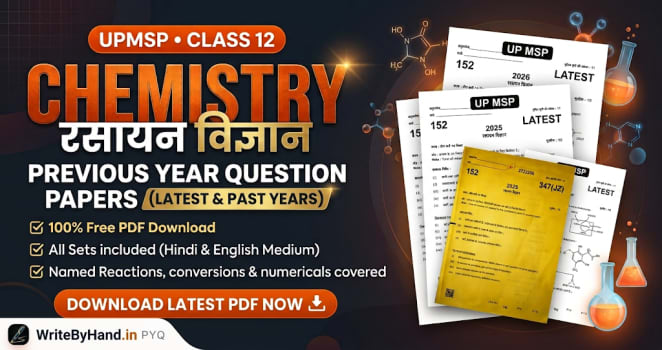
Decoding the UP Board Class 12 Chemistry 70-Marks Blueprint 2026
Analyzing the up board class 12 chemistry 70 marks paper blueprint and weightage allows you to prioritize chapters that guarantee maximum marks with minimal effort. The UPMSP Class 12 Rasayan Vigyan written exam carries 70 marks (with 30 marks reserved for school practicals) and consists of 7 compulsory main questions covering MCQs (1 mark), Short Answers (2 marks & 3 marks), Analytical Questions (4 marks), and Long Descriptive Questions (5 marks). Here is the official division across Physical, Inorganic, and Organic Chemistry:
- Physical & Inorganic Chemistry: Solutions (8 Marks), Electrochemistry (7 Marks), Kinetics (7 Marks) & d-f Block / Coordination (13 Marks) Together, Physical Chemistry (22 marks) and Inorganic Chemistry (13 marks—comprising d & f Block Elements for 6 marks and Coordination Compounds for 7 marks) account for 35 out of 70 marks! Reviewing any class 12 chemistry chapter wise important questions up board pdf confirms that practicing physical chemistry numericals class 12 up board repeated questions (such as Colligative Properties, Nernst Equation, Kohlrausch's Law, First-Order half-life, Lanthanoid contraction, and IUPAC naming of coordination complexes) secures guaranteed full marks without subjective deductions.
- Organic Chemistry & Biomolecules (35 Marks Total Weightage) The second half of the paper (Haloalkanes & Haloarenes: 7 marks, Alcohols, Phenols & Ethers: 7 marks, Aldehydes, Ketones & Carboxylic Acids: 8 marks, Amines: 6 marks, and Biomolecules: 7 marks) revolves around reaction mechanisms and tests. Mastering class 12 chemistry named reactions and conversions up board—including "What happens when" (क्या होता है जब) and "How will you obtain" (कैसे प्राप्त करेंगे)—ensures effortless success in the 5-mark long-answer section.
High-Yield Named Reactions, Numericals & 5-Mark Topics That Repeat Every Year:
- Raoult's Law, Osmotic Pressure & Van't Hoff Factor Numericals
- Nernst Equation, Kohlrausch's Law & First-Order Rate Constant Derivation
- Werner's Theory, VBT/CFT Hybridization & IUPAC of Coordination Compounds
- Reimer-Tiemann, Kolbe's, Williamson Synthesis & Lucas Test (1°, 2°, 3° Alcohols)
- Aldol Condensation, Cannizzaro, Rosenmund, Clemmensen & Tollens'/Fehling's Test
- Hoffmann Bromamide, Carbylamine Reaction & Glucose/Protein Structures
Section-Wise Strategy Using UPMSP Class 12 Chemistry Past Papers:
1. Lock in Full Marks in Question 1 MCQs & 2-Mark Conceptual Questions (14 Marks)
Question 1 (6 MCQs of 1 mark each) and Question 2 (4 sub-questions of 2 marks each) test direct formula application and basic reasoning. Going through an up board 12th chemistry unsolved paper pdf free download from the last 5 years shows that questions on unit of rate constants ($k$), molarity/molality calculations, paramagnetic ions in $d$-block, and vitamin deficiency diseases repeat almost verbatim.
2. Dominate the 24-Mark Block of Numericals & Inorganic Reasoning (Questions 3, 4 & 5)
Questions 3 and 4 (2 marks and 3 marks each) along with Question 5 (4 sub-questions of 4 marks each) carry the bulk of Physical Chemistry numericals and Coordination Chemistry. Practicing upmsp 12th chemistry model paper and previous year paper in hindi helps you build a habit of always writing the "Given data", the exact formula, step-by-step substitution, and the final answer with proper SI units (like $\text{mol L}^{-1}\text{ s}^{-1}$ or $\text{S cm}^2\text{ mol}^{-1}$).
3. Conquer 5-Mark Long Questions with Organic Conversions & Named Reactions (20 Marks)
Questions 6 and 7 contain four long-answer sub-questions of 5 marks each (totaling 20 marks) and always include internal "OR" (अथवा) choices. Mastering the class 12 organic chemistry most repeated long questions up board alongside ncert class 12 chemistry previous year board questions upmsp is the ultimate secret for students researching how to score 65 plus in up board class 12 chemistry theory exam. Always choose the "What happens when (give chemical equation only)" or "Named Reaction short notes" option, as 5 balanced equations fetch a straight 5/5 without losing marks on theory length.
How to Practice Effectively with Our UP Board Chemistry Archive:
- Download the up board class 12 chemistry all sets question paper pdf from the year-wise cards above. Compare at least 3 regional sets per year to spot overlapping Organic conversions and Physical Chemistry numericals.
- Maintain a separate reaction notebook for up board intermediate science rasayan vigyan past papers pdf practice. Write down all 25 core NCERT Named Reactions with reagents, temperature conditions, and IUPAC product names.
- Use the initial 15 minutes of reading time to evaluate the internal "OR" (अथवा) choices in Questions 6 and 7—always pick reaction-conversion chains or lab preparation methods (like Diethyl Ether, Acetone, or Formic Acid) that you can back up with balanced equations.
Common Mistakes to Avoid in the Class 12 Chemistry Exam:
- Leaving Chemical Equations Unbalanced or Omitting Reagents: In Organic Chemistry, writing an arrow without specifying the reagent or catalyst (such as $\text{alc. KOH}$, $\text{anhy. AlCl}_3$, or $\text{Pd/BaSO}_4$) leads to immediate half-mark deductions. Always write the reagent above the reaction arrow and name the main product below it.
- Skipping Units in Physical Chemistry Numericals: Even if your calculation for cell EMF ($E_{\text{cell}}$), molar conductivity ($\Lambda_m$), or rate constant ($k$) is 100% accurate, forgetting the final unit costs 0.5 to 1 mark per question.
- Errors in Coordination IUPAC Formatting: When naming coordination compounds, always write the cation first, list ligands in strict alphabetical order before the central metal atom, and indicate the metal's oxidation state in Roman numerals inside parentheses without spaces.
A quick trick to revise Organic Named Reactions & Physical Formulas before the exam:
Revising all 25+ Organic Named Reactions, Electrochemistry formulas, and Coordination ligand series on the morning of the board exam can feel overwhelming.
You can use our free Exam Cheat Sheet Generator tool to create a 1-page Chemistry revision sheet. Compile all important reagents, distinguishing chemical tests, and numerical formulas into a clean A4-sized PDF sheet in seconds!
Are you in need of more free student tools? Then, head over to WriteByHand.in's Homepage and explore our 100+ assignment maker tools, PDF tools, and text-to-handwriting converters!
*Disclaimer: Please note that the above-mentioned past papers have been collected from official UPMSP board releases and previous candidates. WriteByHand.in does not claim ownership of these materials. We are simply sharing these resources to help current students prepare for their UP Board Class 12 board exams.