Ultimate Guide to Mastering the UP Board Class 10 Computer Exam in
Introduction to UPMSP Class 10 Computer Preparation
For High School students under the Uttar Pradesh Madhyamik Shiksha Parishad, Computer (कंप्यूटर) is one of the most technical yet highest-scoring subjects that can dramatically boost your overall 10th board percentage. Solving an official up board class 10 computer previous year question paper within the allotted 3-hour, 15-minute window is the most reliable way to master C language syntax, truth tables, Linux commands, and OMR objectives before the final examination.
Whether you are searching for a complete class 10 computer last 5 years question paper up board pdf or practicing with the latest upmsp class 10 computer question paper 2026 pdf download, a clear pattern emerges immediately: nearly 75% to 80% of programming logic problems, networking definitions, and Boolean algebra questions repeat directly across regional upmsp class 10 computer english and hindi medium paper pdf sets.
Pro tip for UP Board High School students: Boost your overall Class 10 aggregate alongside Computer by practicing your core subjects. Download the UP Board Class 10 Science (Vigyan) PYQs or Class 10 Mathematics (Ganit) Past Papers.
Decoding the UP Board Class 10 Computer 70-Marks Blueprint 2026
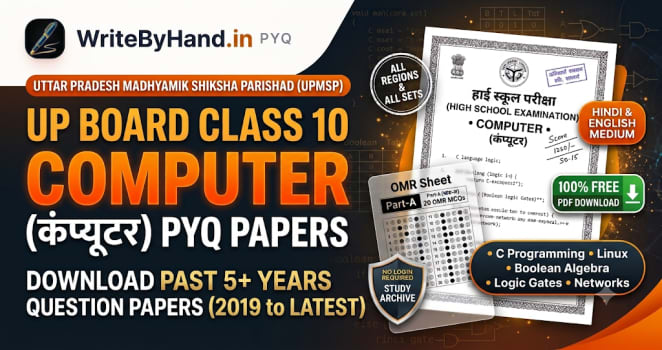
Understanding the up board class 10 computer 70 marks paper blueprint and weightage allows you to focus your revision on high-yield technical units. Under the latest UPMSP High School pattern, the 70-mark written paper is split into two distinct sections: Part-A (खंड-अ) featuring 20 Multiple Choice Questions (20 marks) to be answered on an OMR sheet, and Part-B (खंड-ब) carrying 50 marks of descriptive and programming questions (Definite, Short, and Long answers). Here is how the syllabus weightage breaks down:
-
Core Units: C Programming, Arrays,
Strings & Functions
Programming in C and Web/IT basics account
for the largest share of the theory paper. Going through any class 10 computer
chapter wise important questions up board pdf proves that mastering
c programming and html class 10 up board repeated questions—such as
1D and 2D Arrays, String handling functions (
strlen,strcpy,strcat), Searching & Sorting (Linear/Binary search, Bubble/Selection sort), and File Handling—is the fastest route to securing full marks in long answers. - Scoring Units: Data Communication, Linux OS, Binary Arithmetic & Logic Gates The remaining portion of the exam tests foundational computer science concepts. Revising class 10 computer important questions and answers up board from these units—including Communication Media (Guided/Unguided), LAN/MAN/WAN Topologies, OSI & TCP/IP Models, Linux CLI Commands & Vi Editor, Number System Conversions, and Basic/Universal Logic Gates (AND, OR, NOT, NAND, NOR)—guarantees effortless marks in both OMR and short descriptive questions.
High-Yield C Programs & Long Topics That Repeat Every Year:
- C Programs: Factorial, Fibonacci, Prime Number & Palindrome
- Arrays: Linear/Binary Search, Bubble Sort & 3x3 Matrix Addition
- Boolean Algebra: De-Morgan's Theorems, Truth Tables & Logic Gates
- Networking: OSI 7-Layer Model, Network Topologies & Protocols
- Linux OS: Kernel vs. Shell, File Security & Essential CLI Commands
- AI, Cyber Security, Drone Technology & E-Governance Basics
Section-Wise Strategy Using UPMSP Class 10 Computer Past Papers:
1. Score a Full 20/20 in Part-A OMR Multiple Choice Questions
Part-A consists of 20 MCQs of 1 mark each that must be filled on an OMR sheet.
Practicing with an up board class 10 computer 20 marks omr mcq questions
pdf alongside any up board 10th computer unsolved paper pdf free
download reveals that factual questions on array index starting values
(0), C header files (stdio.h, string.h), full
forms (ASCII, HTTP, TCP/IP,MODEM), binary/hexadecimal conversions, and Linux directory
commands repeat almost word-for-word every year.
2. Structure Crisp Answers for 1-Mark & 2-Mark Short Questions
In Part-B, the short answer sections test concise technical definitions, syntax snippets, and comparisons. Reviewing upmsp 10th computer model paper and previous year paper in hindi will help you write to-the-point bulleted answers for topics like Simplex vs. Half-Duplex vs. Full-Duplex, Compiler vs. Interpreter, Call by Value vs. Call by Reference, and 1's & 2's Complement without wasting time on lengthy paragraphs.
3. Master Long Questions with Clean C Code & Block Diagrams
The long descriptive questions carry the highest marks and offer internal "OR" (अथवा) choices. Practicing the class 10 computer most repeated long questions up board is the ultimate secret for students researching how to score 65 plus in up board class 10 computer theory exam. Whenever a question asks you to explain a C programming concept or write a program, always divide your answer into neat sections: Definition, Syntax, Working Logic/Flowchart, and a Complete C Program with Sample Output.
How to Practice Effectively with Our UP Board Computer Archive:
- Download the up board class 10 computer all sets question paper pdf from the year-wise cards above. Compare at least 2 to 3 sets per year to identify the most frequently asked C language programs and networking questions.
- Maintain a dedicated coding & syntax notebook while solving up board high school computer science past papers pdf sets. Write down the exact C code for top 10 programs (Factorial, Sorting, Searching, Matrix, String Reverse) and all standard library functions.
- Use the first 15 minutes of reading time to solve all 20 OMR questions (especially binary arithmetic) and pick your best "OR" (अथवा) options in the long section—always choose a C program or Logic Gate truth table question to secure full mathematical accuracy marks.
Common Mistakes to Avoid in the Class 10 Computer Exam:
- Missing Semicolons & Header Files in C Programs: Writing C code without
including
#include <stdio.h>, forgetting semicolons (;) at the end of statements, or using wrong format specifiers (like%dvs%s) leads to unnecessary mark deductions. - Overwriting or Using Whitener on the OMR Sheet: In the 20-mark Part-A OMR section, never use a whitener, blade, or partial shading. Darken the circle completely with a black or blue ballpoint pen only after verifying the option.
- Skipping Truth Tables & Circuit Diagrams: When answering questions on Logic Gates (AND, OR, NOT, NAND, NOR, XOR) or Network Topologies (Star, Ring, Bus, Mesh), always draw a neat pencil diagram and truth table to stand out to the UPMSP examiner.
A quick trick to revise C Syntax, Linux Commands & Logic Gates before the exam:
Revising all C library functions, array syntax, Linux commands, truth tables, and full forms on the morning of the board exam can feel overwhelming.
You can use our free Exam Cheat Sheet Generator tool to create a 1-page Computer Science revision sheet. Compile all important C programs, ASCII values, and networking layers into a clean A4-sized PDF sheet in seconds!
Are you in need of more free student tools? Then, head over to WriteByHand.in's Homepage and explore our 100+ assignment maker tools, PDF tools, and text-to-handwriting converters!
*Disclaimer: Please note that the above-mentioned past papers have been collected from official UPMSP board releases and previous candidates. WriteByHand.in does not claim ownership of these materials. We are simply sharing these resources to help current students prepare for their UP Board Class 10 board exams.