Ultimate Guide to Mastering HBSE Class 12 Maths Exam in
Introduction to HBSE Maths Preparation
For Science and Commerce students alike, Mathematics is an intensely analytical subject that demands rigorous daily practice, crystal clear formula retention, and swift calculation skills. Simply reading NCERT or Elements of Mathematics is rarely enough to secure a perfect 100. By deeply analyzing the Haryana Board (BSEH) Class 12 Maths Previous Year Question Papers (Up to ), you can decode the exact board blueprint.
Over the years, the Haryana Board has consistently repeated high-weightage concepts. From complex definite integrals and linear differential equations, to calculating the shortest distance between skew lines in 3D Geometry—practicing these past year PDFs will drastically improve your calculation speed, time management, and understanding of the strict step-marking criteria.
Pro Tip for Science Students: Boost your overall board percentage by practicing other core subjects. Download the HBSE Class 12 Physics PYQs and the HBSE Class 12 Chemistry PYQs.
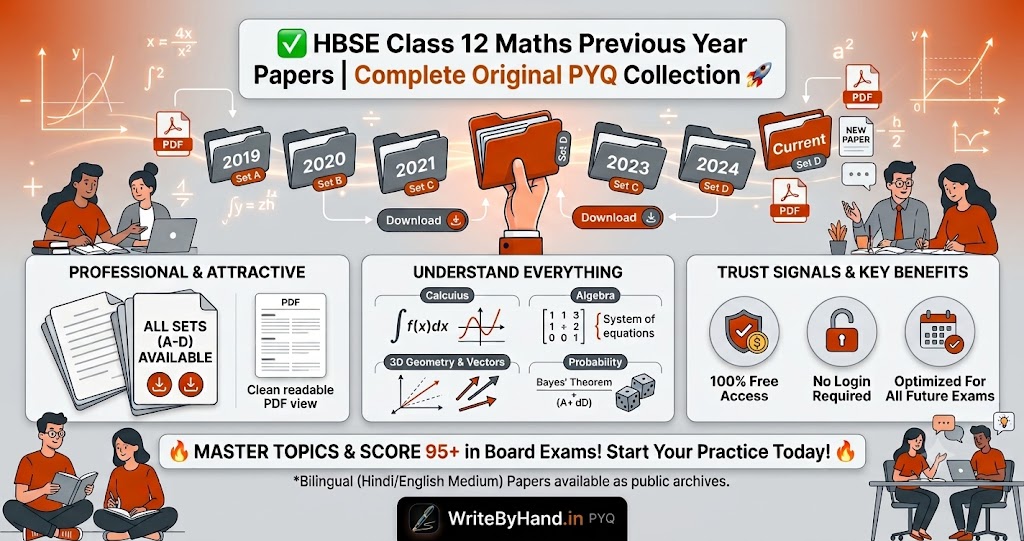
Decoding the HBSE Class 12 Maths Blueprint
The HBSE Class 12 Maths paper consists of 80 marks of pure analytical problem-solving. You will encounter questions ranging from quick 1-mark objective formulas to extensive 5-mark long answers (often from Calculus or Algebra). Here is how you should prioritize your revision:
- 1. Calculus (~35 Marks) The undisputed king of the syllabus. Master Continuity, Applications of Derivatives (AOD), Integration, and Differential Equations. Expect 5-mark questions testing Area Under the Curve or linear differential equations.
- 2. Vectors & 3D Geometry (~14 Marks) Highly scoring if you memorize the standard forms. You will definitely see questions on finding the shortest distance between skew lines, and finding the foot of the perpendicular.
- 3. Algebra (~10 Marks) Matrices and Determinants. It is an almost certainty that a 5-mark question will ask you to solve a system of linear equations using the Matrix Inverse Method.
Syllabus & Chapter-Wise Weightage
| Unit Name (NLP Entities) | Approx. Marks Weightage |
|---|---|
| Calculus (Integrals, Derivatives, Differential Eq.) | 35 Marks |
| Vectors & 3-Dimensional Geometry | 14 Marks |
| Algebra (Matrices & Determinants) | 10 Marks |
| Probability (Bayes' Theorem, Distribution) | 8 Marks |
| Relations and Functions (Inverse Trig) | 8 Marks |
| Linear Programming (LPP) | 5 Marks |
Chapter-Wise Preparation Strategy Using Past Papers
1. Conquer Calculus First
When you review PYQs from 2019 to , you will notice a trend. Questions on substituting limits in Definite Integrals and solving homogeneous differential equations repeat every year. Do not rote learn solutions. Make a separate formula sheet just for standard integrals.
2. Secure Algebra & Probability
Matrices and Determinants are massive score boosters. Always re-check your sign conventions (+ and -) while calculating co-factors for adjoint matrices. For Probability, practice Bayes' Theorem thoroughly—it's a board favorite that guarantees 4-5 marks.
3. Master Step-Marking
Haryana Board rigorously follows a step-marking scheme. If a question feels too complex (like a tough 3D Geometry problem), DO NOT leave it blank. Write the given values, formulate the standard equation (e.g., Shortest Distance formula), and attempt the initial steps. You will secure partial marks!
Core Syllabus Entities & Important Topics
- Definite & Indefinite Integrals
- Matrix Inverse Method (Linear Eq)
- Bayes' Theorem & Probability
- Shortest Distance (Skew Lines)
- Linear Programming Graphs (LPP)
How to Utilize These PYQ Archives Effectively?
Follow this guide to download and use original Haryana Board past papers for Maths revision.
- Phase 1: Topical Practice: Don't try to solve full papers early on. As soon as you finish a chapter like 'Integrals', open these past papers and attempt all the 3-mark and 5-mark questions related to that specific topic.
- Phase 2: Step-Marking Awareness: Understand the board's step-marking. Writing correct formulas and intermediate mathematical logic fetches marks even if the final calculation is incorrect. Always attempt the questions!
- Phase 3: The 3-Hour Simulation: In January and February, attempt full papers like the 2024 Set A. Sit quietly for 3 hours and solve your answers exactly as you would in the final board exam to build speed and accuracy.
Common Pitfalls to Avoid in HBSE Maths Exam
- Forgetting the Constant of Integration: Missing `+ C` in indefinite integrals will cost you 0.5 marks every single time.
- Graph without Labels: Drawing an LPP or Area Under Curve graph without labeling the intersecting coordinates and equations on the lines.
- Skipping Base Formulas: Directly putting values into a calculation without writing the main formula first (e.g., Shortest Distance formula) leads to a huge loss in step marks.
- Wasting Time on Dead Ends: Getting stuck on a complicated matrix multiplication and wasting 15 minutes. Leave some space and move forward!
Pro Revision Tip for Board Exams
Class 12 Maths has a massive syllabus with hundreds of formulas—Integration standards, Trigonometry identities, and 3D Geometry properties. Revising from thick books 24 hours before the exam causes unnecessary stress.
Solution: Use our exclusive Exam Cheat Sheet Generator. You can compile all your crucial Maths formulas into a compact, highly organized A4 PDF sheet for quick last-minute revision!
Looking for more free student tools? Explore the WriteByHand.in Homepage for assignment makers, PDF tools, and text-to-handwriting converters!
*Disclaimer: These question papers are sourced from public domains and previous students' archives. WriteByHand.in is providing these for educational purposes to help students prepare for their upcoming BSEH examinations.