Ultimate Guide to Mastering HBSE Class 10 Social Science Exam in
Introduction to HBSE SST Preparation
Scoring a 95+ in Class 10 Social Science (SST) is all about smart revision. Unlike Math or Science, SST requires you to remember historical dates, political structures, economic concepts, and geographical map pointing. By solving the Haryana Board (BSEH) Class 10 Social Science Previous Year Question Papers (Up to ), you will quickly realize that the board repeats certain chapters and map locations almost every year.
Whether it's the Nationalism in India chapter from History or Power Sharing from Civics, practicing these PDF papers will teach you how to write perfect point-wise long answers that examiners love.
Pro Tip for Class 10 Students: Don't ignore your core subjects! Boost your percentage by downloading the HBSE Class 10 Science PYQs and the HBSE Class 10 Mathematics PYQs.
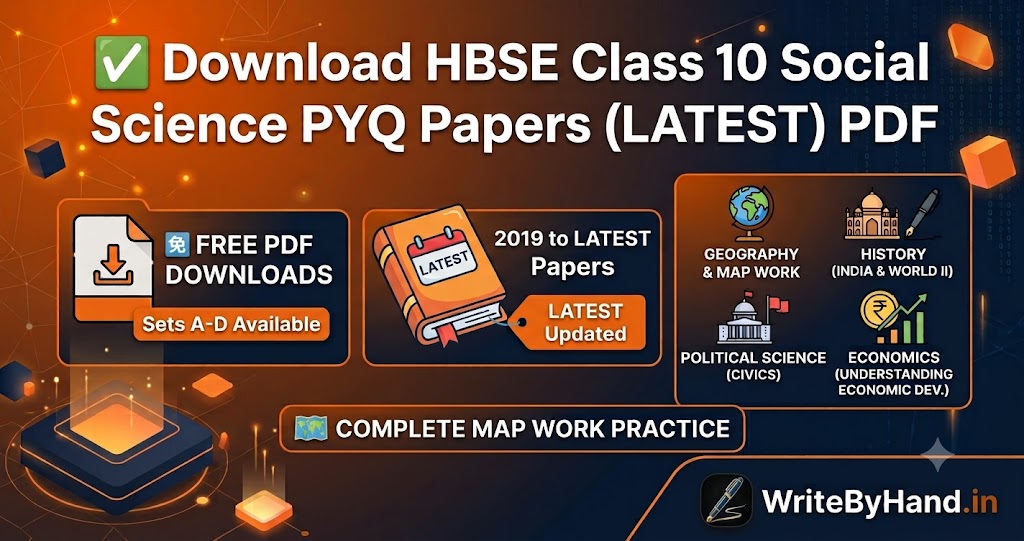
Decoding the HBSE Class 10 Social Science Blueprint
The HBSE Class 10 SST paper is usually divided into four main sections (books) plus a dedicated Map pointing question. The distribution is generally balanced, so you cannot afford to skip an entire book. Here is how you should prioritize:
- 1. History (India and the Contemporary World-II) Focus on chapters like Nationalism in India and The Rise of Nationalism in Europe. Long answers (5 markers) frequently come from these two chapters.
- 2. Geography (Contemporary India-II) & Map Work Highly scoring! Apart from theory questions on Agriculture and Resources, you will face a compulsory 5-mark Map Pointing question. Practice locating Dams, Soil types, and major Airports.
- 3. Civics & Economics Civics (Democratic Politics) focuses heavily on Power Sharing and Federalism. Economics is the easiest section—focus on Sectors of the Indian Economy and Globalization.
SST Sections & Approx Weightage
| Section | Book Name (NLP Entities) | Approx. Marks Weightage |
|---|---|---|
| Part I | History (India & Contemporary World II) | 20 Marks |
| Part II | Geography (Contemporary India II) | 20 Marks |
| Part III | Political Science (Democratic Politics II) | 20 Marks |
| Part IV | Economics (Understanding Economic Dev.) | 15 Marks |
| Part V | Map Pointing (Geography + History) | 05 Marks |
Section-Wise Preparation Strategy Using Past Papers
1. Practice Writing in Points
When you check the marking scheme of previous papers, you will see that examiners prefer bullet points over long paragraphs. For a 3-mark question, write 3 distinct points with short headings. For a 5-mark question, write an introduction, 5 points, and a brief conclusion.
2. Master the Map Work
Never leave the Map question empty. Download the and 2024 PYQs from above and note down every location asked (e.g., Jallianwala Bagh, Bhakra Nangal Dam). Practice them on a physical blank map of India until you memorize the exact states.
3. Create Date Timelines for History
History can be confusing due to numerous dates. Create a chronological timeline for the Nationalism in India chapter (1915 to 1932). Keeping a cheat sheet of these dates will help you tackle 1-mark MCQs effortlessly.
Core SST Entities & Important Topics
- Non-Cooperation & Civil Disobedience Movement
- Major Dams & Soil Types (Map Work)
- Federalism vs Unitary Government
- Formal and Informal Sectors of Credit
- Impact of Globalization on India
How to Utilize These PYQ Archives Effectively?
Follow this guide to download and use original Haryana Board past papers for Social Science revision.
- Phase 1: Filter Repeated Questions: Download the PDFs from 2019 to 2024. Read through them and highlight the questions that appear in at least 3 different years. These are your "Super Important" topics.
- Phase 2: Practice Map Work Separately: Buy 10 blank political maps of India. Open the previous year papers and plot all the asked locations yourself. This builds visual memory.
- Phase 3: The 3-Hour Offline Simulation: One month before the board exam, attempt a full paper (like 2024 Set A). Time yourself strictly for 3 hours to improve your writing speed, as SST papers are notoriously lengthy.
Common Pitfalls to Avoid in HBSE Social Science Exam
- Writing Essay-Type Answers: Avoid writing huge blocks of text. Examiners lose interest. Use headings, subheadings, and bullet points.
- Forgetting Map Index: When you mark locations on a map, always draw a small index/key box at the bottom explaining what your symbols mean.
- Ignoring Economics: Many students focus only on History and Geography. Economics chapters are shorter and much easier to score full marks in.
- Time Mismanagement: Don't spend 30 minutes on a 3-mark question. Stick to word limits (e.g., 60-80 words for 3 marks) to finish the paper on time.
Pro Revision Tip for Board Exams
Social Science requires remembering hundreds of dates, definitions, and locations. Reading through heavy NCERT books 24 hours before the exam causes unnecessary panic.
Solution: Use our exclusive Exam Cheat Sheet Generator. You can compile all your crucial dates, map lists, and quick-points into a compact, highly organized A4 PDF sheet for quick last-minute revision!
Looking for more free student tools? Explore the WriteByHand.in Homepage for assignment makers, PDF tools, and text-to-handwriting converters!
*Disclaimer: These question papers are sourced from public domains and previous students' archives. WriteByHand.in is providing these for educational purposes to help students prepare for their upcoming BSEH examinations.