Ultimate Guide to Mastering HBSE Class 10 Punjabi Exam in
Introduction to HBSE Punjabi Preparation
Scoring high marks in language subjects like Punjabi requires excellent writing skills, strong grammar, and a deep understanding of literature. By analyzing the Haryana Board (BSEH) Class 10 Punjabi Previous Year Question Papers (Up to ), you will easily understand the exact types of essays, letters, and grammar rules the board prefers to test.
Over the years, the Haryana Board has consistently repeated certain topics in 'Lekh Rachna' (Essay) and 'Pattar Rachna' (Letters). Practicing these past year PDFs will drastically improve your writing speed, spelling accuracy, and overall presentation.
Pro Tip for Class 10 Students: Boost your overall board percentage by practicing other core subjects. Download the HBSE Class 10 Hindi PYQs and the HBSE Class 10 English PYQs.
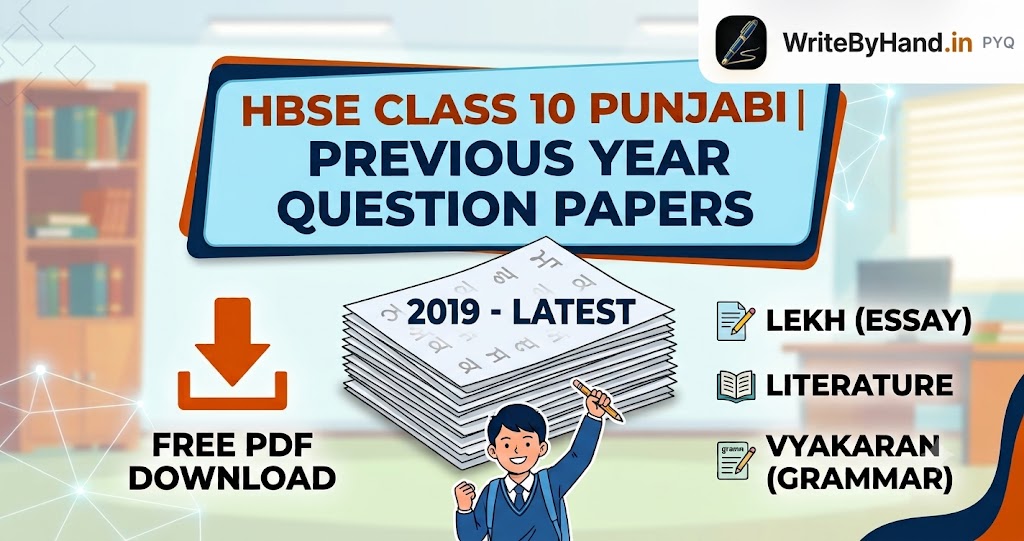
Decoding the HBSE Class 10 Punjabi Blueprint
The HBSE Class 10 Punjabi paper evaluates a student's reading, writing, grammar, and literature skills. To score 90+, you need to divide your preparation time according to the board's marking scheme.
- 1. Reading Section (Unditha Pera) Usually involves an unseen passage. It is highly scoring as answers are hidden within the paragraph itself. Practice 10-15 passages from PYQs to gain speed.
- 2. Vyakaran (Grammar) & Writing Skills Contains essays (Lekh), letters (Pattar), and grammar questions like Muhavare (Idioms), Ling, Vachan, and sentence corrections. Perfecting grammar guarantees solid marks.
- 3. Literature (Sahit Mala & Vangi) This section carries the maximum marks. Focus heavily on character sketches, central ideas of poems (Kavita da saar), and long answer questions from the Vangi textbook.
Syllabus & Section-Wise Weightage
| Section | Core Topics (NLP Entities) | Approx. Importance |
|---|---|---|
| Reading Comprehension | Unditha Pera (Unseen Passage) | High Scoring |
| Writing Skills | Lekh Rachna (Essay), Pattar Rachna (Letter) | Crucial |
| Grammar | Vyakaran (Muhavare, Ling, Vachan, Vishram Chinn) | Very Important |
| Literature Textbooks | Sahit Mala & Vangi (Poetry, Prose) | Maximum Weightage |
Section-Wise Preparation Strategy Using Past Papers
1. Master the Grammar (Vyakaran)
When you review PYQs from 2019 to , you will notice a trend. Questions on idioms (Muhavare) and sentence correction repeat frequently. Make a list of all grammar questions from past papers and revise them daily.
2. Essay & Letter Formats
Focus heavily on formatting. In 'Pattar Rachna' (Letter writing), examiners look for correct placement of the date, address, and salutation. For 'Lekh Rachna' (Essays), practice writing clear introductions and conclusions based on topics asked in 2023 and 2024.
3. Literature (Kavita & Kahaani)
Memorize the names of poets and authors. Questions asking for the "Central Idea" (Kavita da saar) or character sketches from the 'Vangi' book carry heavy marks. Past papers will show you exactly which chapters the board favors.
Core Syllabus Entities & Important Topics
- Punjabi Vyakaran & Muhavare
- Lekh Rachna (Essay Writing)
- Pattar Rachna (Formal/Informal Letters)
- Sahit Mala (Poetry Central Ideas)
- Vangi (Character Sketches)
How to Utilize These PYQ Archives Effectively?
Follow this guide to download and use original Haryana Board past papers for Punjabi revision.
- Phase 1: Format Practice: Start by downloading a recent paper (e.g., 2024). Look at the letter and essay sections. Practice writing the formats on a blank sheet of paper to lock them in your memory.
- Phase 2: Grammar Marathon: Open all sets (A, B, C, D) from 2019 to 2023. Solve ONLY the grammar sections back-to-back. This builds massive confidence for 1-mark questions.
- Phase 3: The 3-Hour Offline Simulation: In January, attempt full papers. Crucially, focus on your handwriting (Likhai) and spelling (Shudh-Ashudh). Good handwriting leaves a great impression on language examiners.
Common Pitfalls to Avoid in Language Exams
- Spelling Mistakes (Shabad Jorh): Punjabi is a phonetic language. Incorrect spellings of 'Matras' can change the meaning of a word entirely and deduct marks.
- Ignoring the Word Limit: Don't write a 5-page essay if the question asks for 200 words. Stick to the word limit to save time for literature questions.
- Forgetting Author/Poet Names: Always mention the poet's name when writing the central idea of a poem. It shows deep textbook knowledge.
- Poor Handwriting: In language papers, neat and legible handwriting can easily fetch you a few extra marks. Avoid excessive cutting or scribbling.
Pro Revision Tip for Board Exams
Revising all grammar rules, poem summaries, and character sketches 24 hours before the exam can cause unnecessary stress.
Solution: Use our exclusive Exam Cheat Sheet Generator. Compile your grammar rules, idioms, and poet names into a compact A4 PDF sheet for quick last-minute revision!
Looking for more free student tools? Explore the WriteByHand.in Homepage for assignment makers, PDF tools, and text-to-handwriting converters!
*Disclaimer: These question papers are sourced from public domains and previous students' archives. WriteByHand.in is providing these for educational purposes to help students prepare for their upcoming BSEH examinations.